


September 18-27, 2026!
Free Teacher Film Resources
The Trees & Seas Film Festival, an initiative of Plastic Oceans.org, is a fantastic opportunity for your students to benefit from watching and discussing exceptional environmental films between Sept. 18-27, 2026.
Some films are still available from 2025 as well. Scroll to view.
Benefits:
Through We Save the World’s Partnership with Plastic Oceans,
it’s Free!
-
Your students can watch fantastic short films on environmental topics
-
Each Film can become an inspiring lesson & help you meet NGSS
-
Films address topics like disappearing biodiversity, carbon capture by forests, global warming affecting communities at high altitudes, and human beings coping with extreme weather events.
-
We’ve previewed the whole collection to help recommend films most appropriate for specific grade levels, so you don’t have to spend time doing it.

Moriah recommends this 20 minute film for 6th grade and up. Her favorite film she previewed this year!


Moriah recommends this 8 minute film for elementary school classes. Probably best for 3rd grade and up.


Moriah & Bridget recommend this 6 minute film for 5th grade and up. In Thai with English subtitles. A good conversation starter.


Moriah recommends this 22 minute film for 3rd grade and up. It is mostly in English with a little bit of Spanish. There are subtitles throughout.


Moriah recommends this 12 minute film for 5th grade and up. However for Dual Immersion programs, it could be a good fir for 3rd or 4th graders.

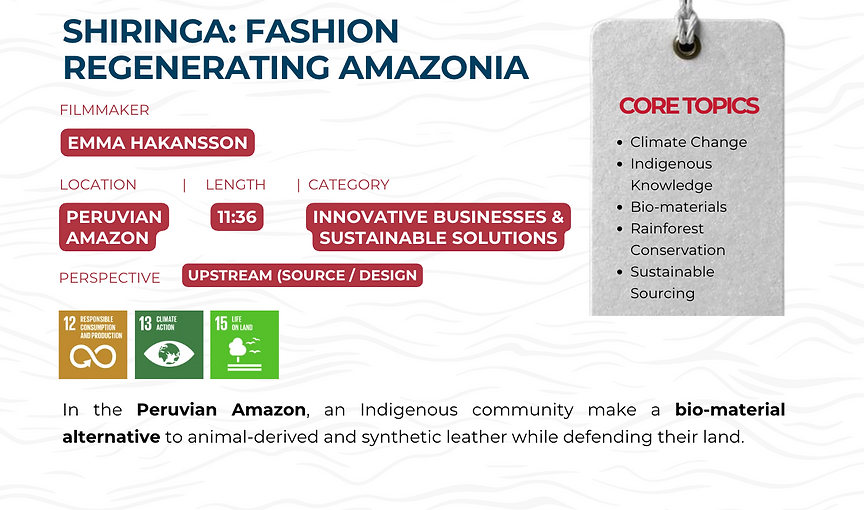
Moriah recommends this 14 minute film for Spanish Dual Immersion programs or high school level Spanish classes. The film is in Spanish with subtitles. It is also suitable for High school English or Science classes.


Moriah recommends this6 minute film for 4th grade and up.


Moriah & Bridget recommend this 5 minute film for older high school students. It confronts climate change danger in a forceful way which may be emotionally challenging for students.


Films Still Available from 2025

Here the Wild Things Are (9 Min)
available on YouTube. Click Here.
A live-action film recommended for all grades.
Here the Wild Things Are chronicles a friendly competition between two towns in New Zealand to win a citizen science initiative. Hundreds of people of all ages take photos and collect audio samples of the species in their environments. Everyone learns a lot and has fun!
These activities are part of a wider global effort which takes place in April and May each year. Your class may want to participate too after watching how much fun it is! - https://www.citynaturechallenge.org/about (this challenge began as a competition involving the California Academy of Science in San Francisco)
Discussion Questions
-
How many species did they identify?
-
How many species do you think you could identify?
-
Why do you think it is important to identify species in cities?
Some Related NGSS (samples from 2nd, 3rd, 5th, Middle School)
-
https://www.nextgenscience.org/pe/2-ls4-1-biological-evolution-unity-and-diversity - compare the diversity of life
-
https://www.nextgenscience.org/pe/3-ls4-3-biological-evolution-unity-and-diversity - particular habitats affect species’ survival
-
https://www.nextgenscience.org/pe/5-ls2-1-ecosystems-interactions-energy-and-dynamics - develop a model to describe the movement of matter within an eco-system
-
https://www.nextgenscience.org/dci-arrangement/ms-ls2-ecosystems-interactions-energy-and-dynamics - Analyze and interpret data to provide evidence for the effects of resource availability on organisms and populations of organisms in an ecosystem.

Recommended for 9th-12th Grades due to subtitles and sophisticated vocabulary and concepts. Possibly 7th and 8th grades?
Tucked between towering Himalayan peaks, Bhutan stands as a global beacon of environmental leadership. With constitutional forest protection and 100% hydro-powered energy, it absorbs more carbon than it emits. But even this green paradise is under threat. Bhutan: Green Paradise joins scientists on a rare expedition to a glacial lake on the verge of collapse, uncovering the imminent dangers of climate change in one of the world’s most climate-resilient nations.
Discussion Questions
-
Where is Bhutan located?
-
Why are trees/forests important?
-
What is meant by “Gross National Happiness?”
-
Why is the monsoon season important in Bhutan?
-
Where do they get their electricity from?
-
What roles does water play in Bhutan?
-
What are individuals in the film doing to address the impacts of climate change?
-
What does it mean to be “carbon negative”?
-
What parallels are there between the actions taken to mitigate damage from extreme weather in Bhutan and those being taken in your own community?
Some Related NGSS (samples from middle school and high school)
-
https://www.nextgenscience.org/pe/ms-ess3-3-earth-and-human-activity - design a method to monitor and mitigate human impact on the environment
-
https://www.nextgenscience.org/pe/hs-ls2-6-ecosystems-interactions-energy-and-dynamics - evaluate data about how changing conditions may result in new ecosystems
-
https://www.nextgenscience.org/pe/hs-ls2-7-ecosystems-interactions-energy-and-dynamics - evaluate designs for reducing human impacts on biodiversity

Team Ocean Quest (52 min)
available on YouTube. Click Here.
Recommended for 6th-12th Grades. Major STEM focus!!
This inspirational film chronicles the exciting ups and downs of a team junior high and high school students from San Jose, CA who enter the X Prize Ocean Discovery competition with their innovation and perseverance and go on to win against a sea of grownup professional engineers! Note: The school the children attend is a Christian school, so every once in a while when things are going badly, they pray.
Discussion Questions
-
What diverse skills are represented in the group of students?
-
Have you ever thought about competing with your skills in a STEM-oriented competiton?
-
Why do you think they were successful?
-
What were the team's biggest challenges?
-
Why is it okay to fail sometimes?
-
What is something you'd like to invent or create with engineering skills, if you could figure it out?
-
What are the pros and cons of working with a team?
-
Did the autonomous underwater vehicle (AUV) respond differently in fresh water and salt water?
Some Related NGSS (samples from middle school and high school)
-
https://www.nextgenscience.org/pe/ms-ps2-2-motion-and-stability-forces-and-interactions - explore what factors influence how an object moves through water with a varying level of salinity
-
https://www.nextgenscience.org/pe/hs-ps2-1-motion-and-stability-forces-and-interactions - consider how Newston's Second Law of Motion would apply to the functioning of the AUV

To Tatou Wai Our Water (46 min)
available through EcoFlix
Recommended for 7th-12th Grades due to length and complexity
New Zealand is facing a water crisis. With 60% of Aotearoa’s rivers deemed unswimmable, the nation’s clean, green image—and the health of its people—is at risk. While political solutions remain stalled, Māori-led initiatives are rising to the challenge. This documentary follows the powerful grassroots efforts of iwi working to restore and protect their waterways for future generations.
.
Discussion Questions
-
Why is water our most valuable resource?
-
What are the major issues the waterways are facing?
-
Do we face similar water challenges locally?
-
How are they addressing runoff? Do you know how runoff is being addressed locally?
-
How does “bad water” affect people?
-
How are you connected with water?
-
Who are the Maori?
-
What is riparian planting and what are the benefits?
-
What programs do you know in your community focused on water and habitat?
-
Did you learn any words or phrases specific to the community in the film?
-
What is the trouble with fertilizer?
-
What have you learned about nitrogen in the soil and rivers?
-
What are the benefits of biodiversity?
-
What are the benefits of multispecies pastures?
-
How has this film inspired you?
Some Related NGSS (samples from middle school and high school)
-
https://www.nextgenscience.org/pe/ms-ess3-3-earth-and-human-activity - design a method to monitor and mitigate human impact on the environment
-
https://www.nextgenscience.org/pe/hs-ls2-7-ecosystems-interactions-energy-and-dynamics - evaluate designs for reducing human impacts on biodiversity
We'd Love Your Feedback! Did you enjoy the Festival? What could we have done better?
707-483-5800